


1. What is new
Until now the course focused on learning the letters, from pencil warm-ups to dictation. The new stages cover what comes next: themed words, then fun kinds of words such as sound words and opposites, then sentences with particles and punctuation, and finally the sentences you need for a picture diary.
The course is split into sections, stages and levels. Each level has just 2 to 5 words or sentences, so children can finish it and earn stars often.
2. Where to start
Ages are only a guide. An older child who finds final consonants hard can go back to stage 7, and a younger child who knows the letters can move on to vocabulary. Learners of Korean of any age can start at stage 1.
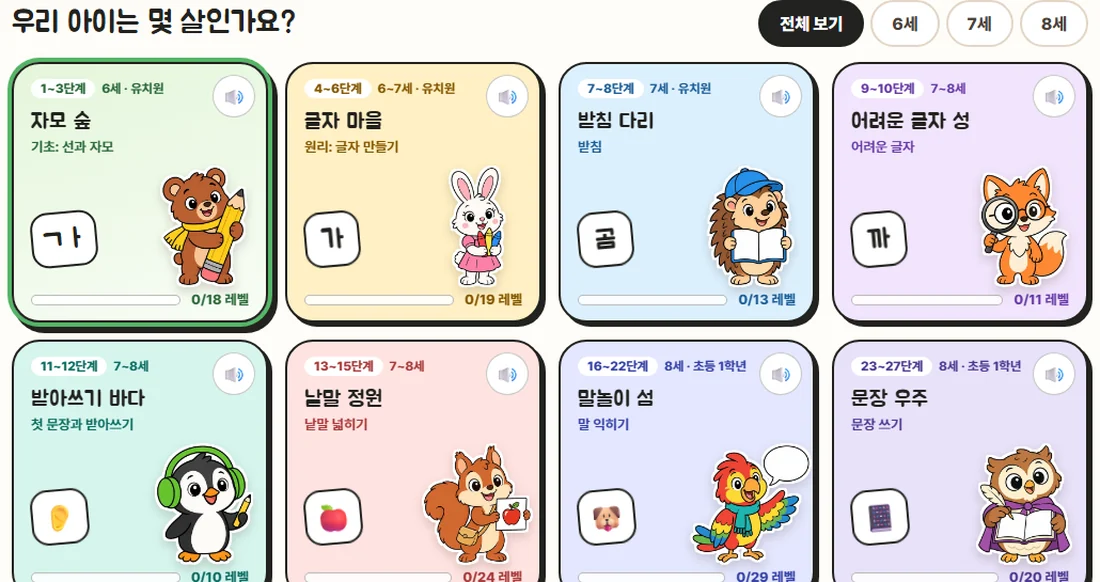
- Around age 6: stage 1 pencil warm-up, stages 2 and 3 vowels and consonants, stages 4 to 6 building syllables and first words
- Around age 7: stages 7 and 8 final consonants, stages 9 and 10 tricky letters, stages 11 and 12 first sentences and dictation
- Around age 8: stages 13 to 15 vocabulary, stages 16 to 22 useful kinds of words, stages 23 to 27 writing sentences
3. The 15 new stages
Growing your vocabulary
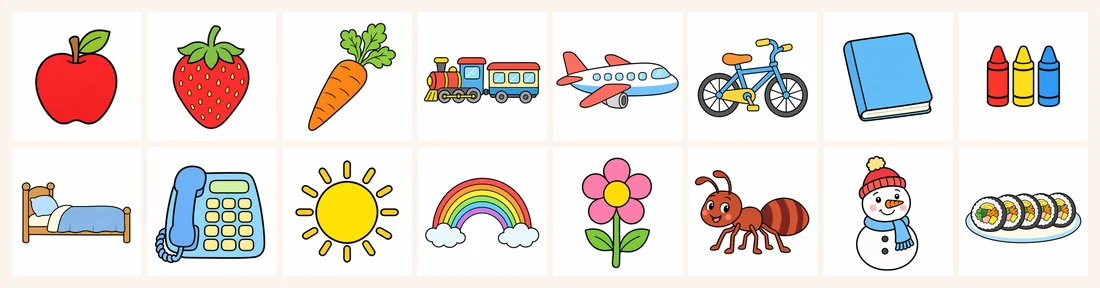
- Stage 13, naming words: fruit, vegetables, vehicles, school things, home, the body, nature and insects (15 levels), most with pictures
- Stage 14, action words: to eat, to run, to read (6 levels)
- Stage 15, compound words: snow + person = snowman (3 levels)
Useful kinds of words
- Stage 16, sound and shape words: 멍멍 (woof), 깡충깡충 (hop hop), 반짝반짝 (twinkle) (5 levels)
- Stage 17, opposites: big and small, open and close (4 levels)
- Stage 18, feeling words: cold, sweet, glad, quickly (4 levels)
- Stage 19, counting words: 개, 마리, 권, 켤레 (2 levels)
- Stage 20, places, times and weather: up and down, yesterday and today, seasons, days of the week, weather (8 levels)
- Stage 21, polite words and words with two meanings (3 levels)
- Stage 22, words that sound different from how they are written (3 levels)
Writing sentences
- Stage 23, particles: 이/가, 을/를, 은/는, 에/에서, 와/과 (5 levels)
- Stage 24, joining words: 그리고, 그래서, 하지만 (3 levels)
- Stage 25, punctuation, written stroke by stroke (4 levels)
- Stage 26, making sentences longer with who, what, when and where (4 levels)
- Stage 27, diary sentences and a final dictation (4 levels)
4. Easy to choose, even before reading
We also rebuilt the level map so children who cannot read yet can find their way. Each area has its own color and animal friend, and age buttons leave only the areas that fit. Choosing an area opens just its stages. Each stage has a number and a picture, and each level is a numbered square. Finished squares change color and the next one pulses.
The 🔊 button reads area and stage names aloud. On the practice screen, new words are read aloud, big stars appear when you finish, and picture words show their picture on the picker too.
5. How the new stages work
The method is the same as in earlier stages: trace to learn the stroke order, copy from a model, then write from sound alone. New stages add a one-line hint under the writing space, such as "Opposite of small", "Two cats" or "After a batchim, use 이", so learners can see why a word is written that way. In Dictation, read the hint first, guess the word, then listen and write.
6. Ten minutes a day
- Choose one level. "Continue" at the top of the map takes you to the next one.
- Finish the tracing, then read what you wrote out loud.
- Talk about the hint. Link it to the day: "What did you eat today that was sweet?"
- If there is time, try Copy or Dictation. If your child gets tired, stop and come back tomorrow.
7. Beyond the screen
After stage 27, try a real picture diary on paper: draw at the top, then write one sentence each for the weather, what you did and how you felt. Any letters that are still hard can be practiced with the printable A4 sheets.
Try the levels from this guide
Open a level to start writing. Every level is open to everyone, and you can try up to 10 levels in each course right away. To keep going, sign up and log in.
FAQ
Is it free?
Yes. Every level is open to everyone, and you can try up to 10 levels per course right away. A free account saves your progress and lets you keep going.
Do I have to go in order?
No. We suggest starting at stage 1, but you can open any level. Where to start by age is at the top of the map.
Is my earlier progress safe?
Yes. Stages 1 to 12 are unchanged, and the new stages follow them. Your stars and passes stay as they were.
Is this the same as a school textbook?
No. These are new exercises made with words and sentences commonly learned at ages 6 to 8.