Korean Words: Zoo and Savanna Animals
Look at each picture and trace the Korean name of 12 zoo and savanna animals over the faint letters. Animals from the zoo and from the grasslands of Africa and Australia. Try it before or after a trip to the zoo.
- Look at the picture and trace the faint word
- Press "Check" to earn one to three stars
- Works with a stylus, a finger or a mouse
Tips
- Words go from short (사자, 하마) to long (얼룩말), so start at the top of the list.
- Write one Korean syllable in each square: top to bottom and left to right, with any final consonant at the bottom.
- Press "Listen" to hear the Korean word, then say it aloud while tracing.
Words in this set
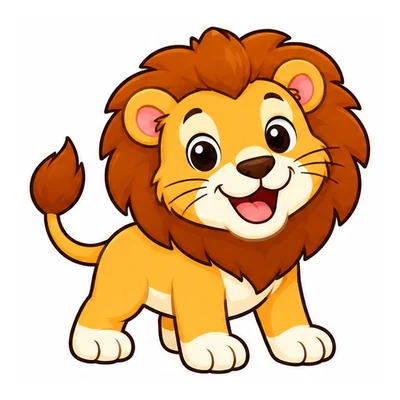 사자lion
 하마hippo
 기린giraffe
 악어crocodile
 낙타camel
 코끼리elephant
 호랑이tiger
 코뿔소rhinoceros
 캥거루kangaroo
 코알라koala
 원숭이monkey
 얼룩말zebra
Words by difficulty
Grouping words by length and by final consonants (batchim) helps you pick the right starting point.
- 2 syllables
- 사자, 하마, 기린, 악어, 낙타
- 3 syllables
- 코끼리, 호랑이, 코뿔소, 캥거루, 코알라, 원숭이, 얼룩말
- No final consonant
- 사자, 하마, 코끼리
- With a final consonant (batchim)
- 기린, 악어, 낙타, 호랑이, 코뿔소, 캥거루, 코알라, 원숭이, 얼룩말
Printable worksheets (Korean + English)
Each A4 page has four animals: trace the Korean name twice and the English name once, then write them alone in the blank boxes. Ready to print with pictures.
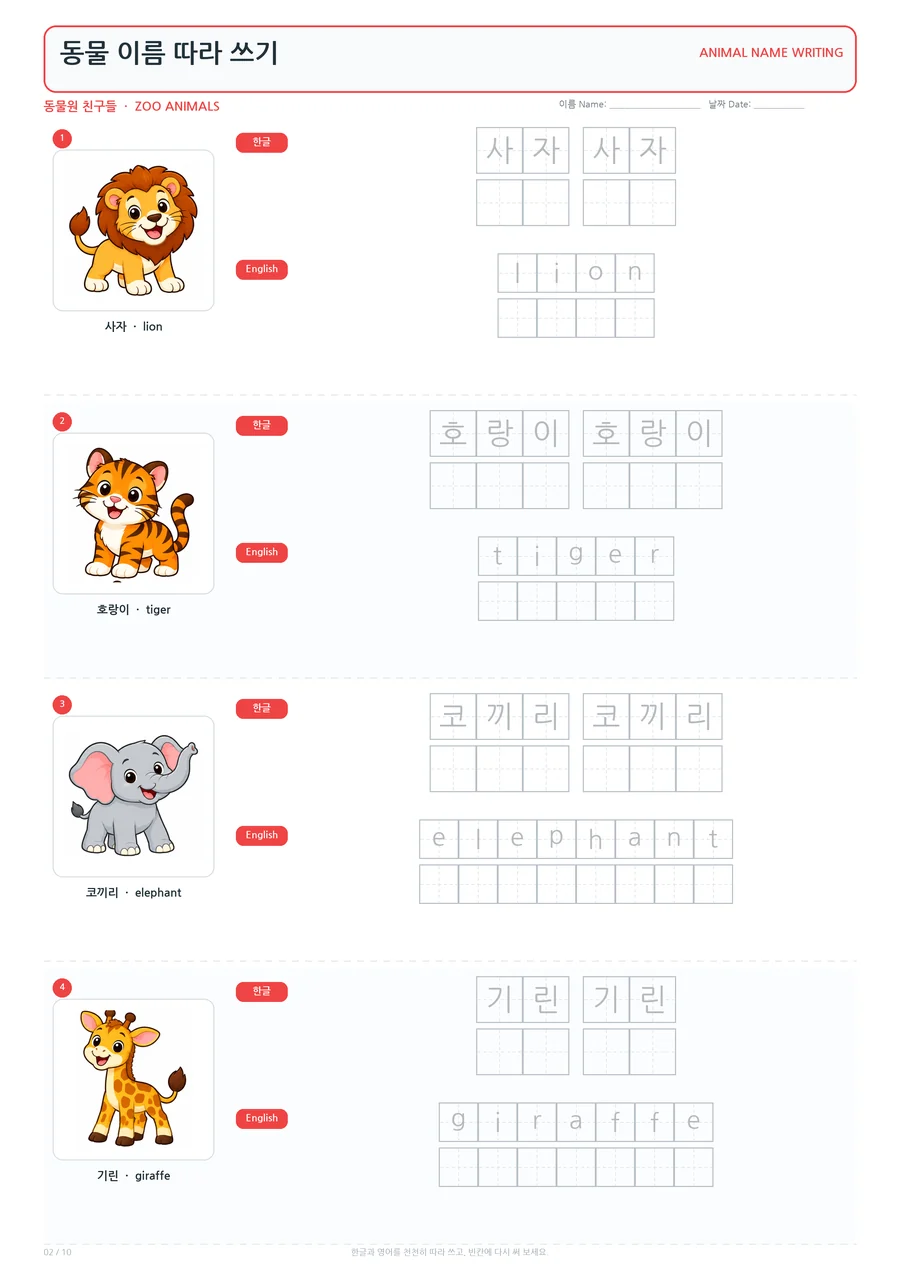

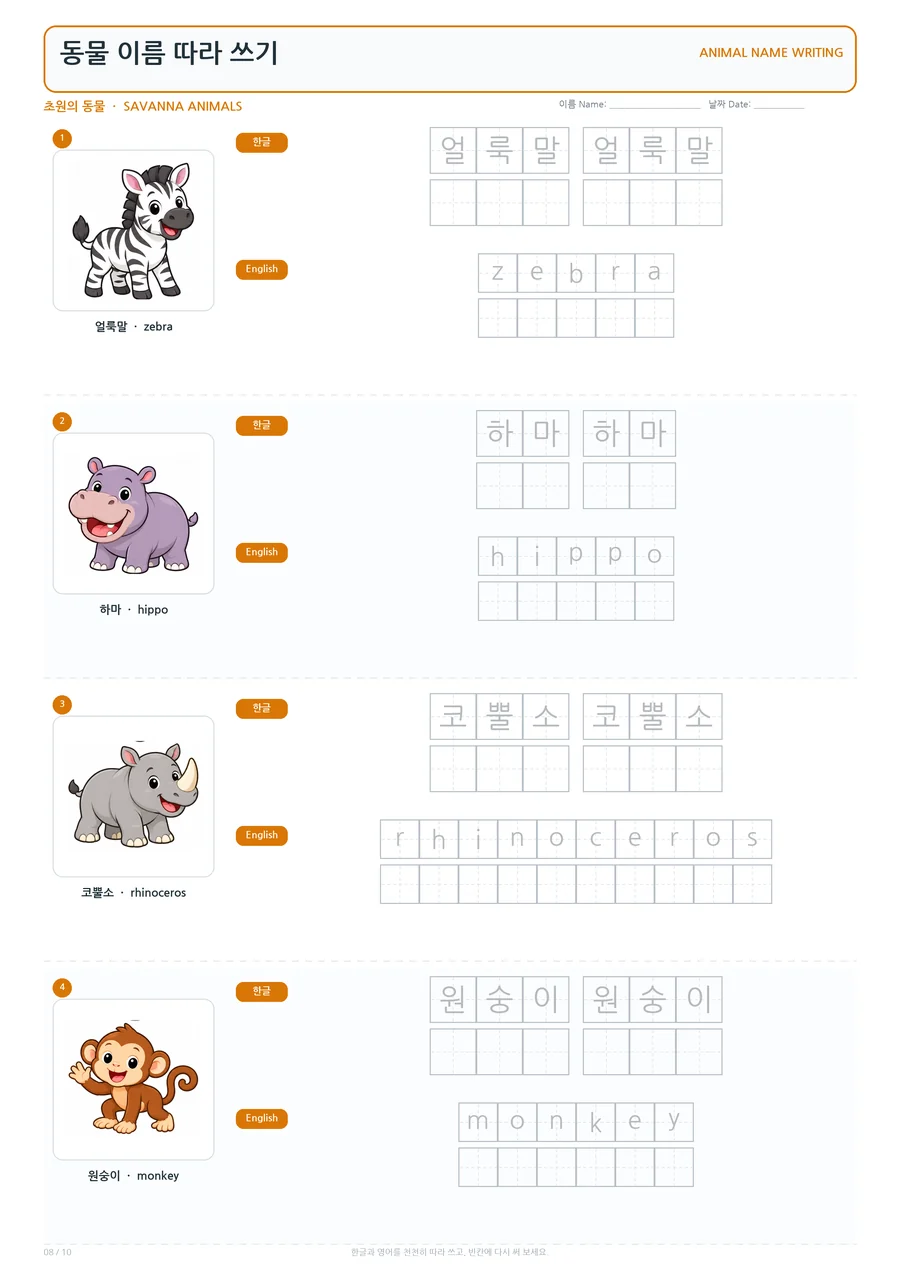

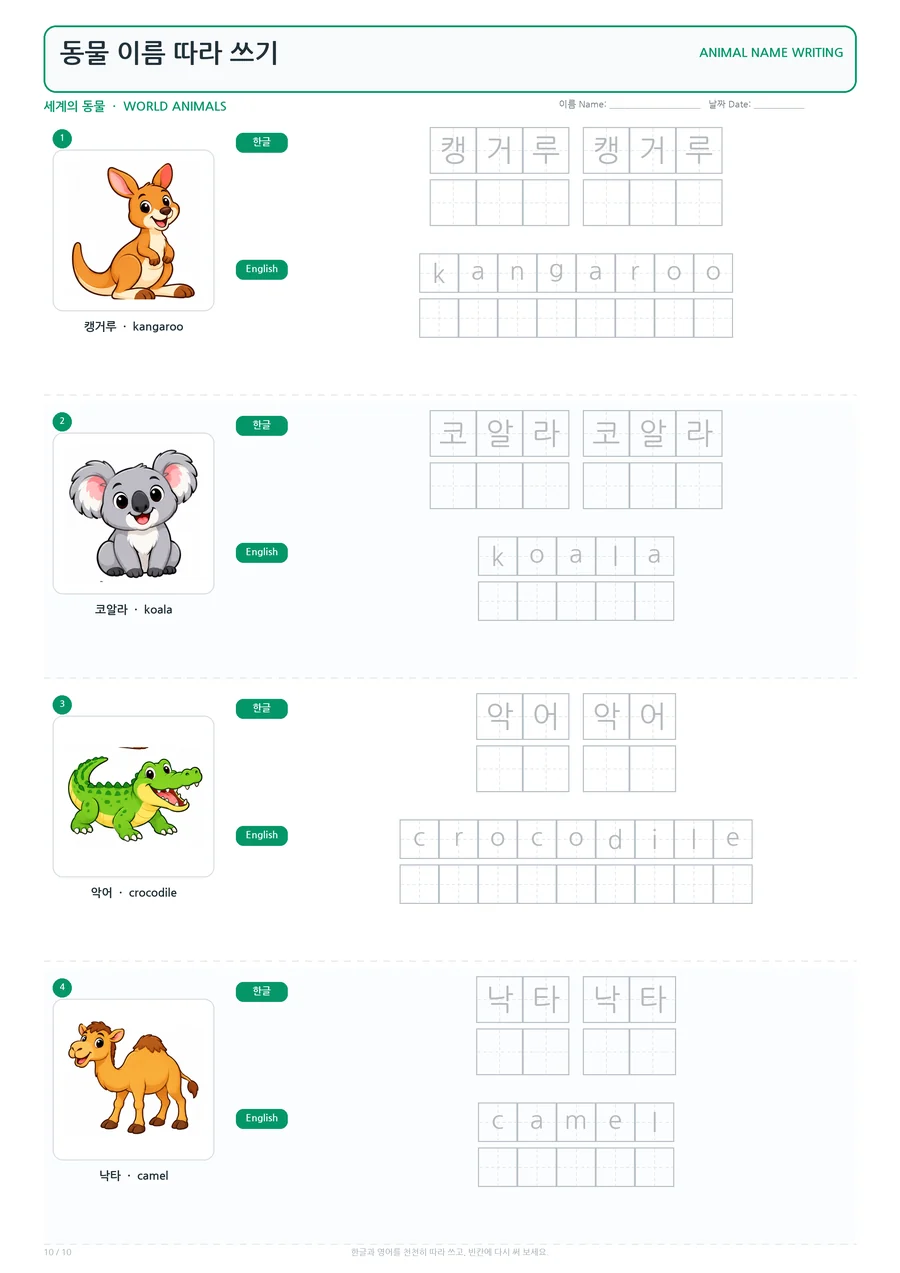

Printable worksheet
Each row has one dark model, four faint letters to trace and one blank box. Print it on A4 or Letter and trace with a pencil.
Korean Words: Zoo and Savanna Animals · ColorBookPage
사자사자사자사자사자하마하마하마하마하마기린기린기린기린기린악어악어악어악어악어낙타낙타낙타낙타낙타코끼리코끼리코끼리코끼리코끼리호랑이호랑이호랑이호랑이호랑이코뿔소코뿔소코뿔소코뿔소코뿔소캥거루캥거루캥거루캥거루캥거루코알라코알라코알라코알라코알라원숭이원숭이원숭이원숭이원숭이얼룩말얼룩말얼룩말얼룩말얼룩말More practice
- Uppercase Letter Tracing A to Z capital letters
- Lowercase Letter Tracing a to z small letters
- Animal Word Tracing bear, lion, elephant and 9 more
- Pets and Farm Animals Word Tracing dog, cat, pig and 11 more
- Zoo and Savanna Animals Word Tracing lion, tiger, zebra and 9 more
- Forest and Garden Animals Word Tracing fox, owl, bee and 11 more
- Ocean and Polar Animals Word Tracing crab, seal, whale and 7 more
- Everyday Objects Word Tracing hat, bag, cup and 9 more
- Korean Consonant Tracing (Hangul) 14 basic consonants ㄱ to ㅎ
- Korean Vowel Tracing (Hangul) 10 basic vowels ㅏ to ㅣ
- Korean Animal Words 12 animal words such as 곰 (bear)
- Korean Words: Pets and Farm Animals 14 Korean words such as 소 (cow), 말 (horse), 양 (sheep)
- Korean Words: Forest and Garden Animals 14 Korean words such as 곰 (bear), 뱀 (snake), 벌 (bee)
- Korean Words: Ocean and Polar Animals 10 Korean words such as 게 (crab), 고래 (whale), 문어 (octopus)
- Korean Words: Everyday Objects 12 Korean words such as 책 (book), 컵 (cup), 공 (ball)
How it works
- Show mePress "Show me" to watch the letter being written. Each stroke has a numbered starting dot and an arrow.
- TraceFollow the faint lines in number order. A correct stroke stays green; if the direction or shape is off, that stroke is shown again.
- Earn starsFinish a letter to earn one to three stars, depending on how closely you traced it. Stars are saved only on this device.
- Write on paperWhen screen practice feels easy, print the worksheet and write the same letters with a pencil.
Why stroke order matters
Stroke order follows the way the hand moves most naturally. Writing in order keeps letters steady and keeps their shape even when writing fast.
Capital letters run from the top line to the baseline; small letters sit between the middle line and the baseline. Notice which letters climb up (b, d, h) and which drop down (g, p, y).
Round letters such as O, C, a and o start near the top and curve to the left.
Writing on a tablet or computer
- Stylus: the closest feel to paper. Once you start with a stylus, a palm resting on the screen will not draw.
- Finger: young children can write big with one finger. A thicker pen size makes tracing easier.
- Mouse: hold the button and drag. Lift at the end of each stroke and start the next one at its number.
At home and in class
- Short sessions of three or four letters a day keep practice fun.
- Use "Listen" to hear the letter or word, then say it aloud while tracing.
- After writing an animal name, color the same animal: the link below each picture opens its coloring page.
Handwriting guides
Questions
Is the writing saved or sent anywhere?
No. Strokes stay on the screen; only the star results are kept in this browser. Pictures you add never leave the device.
Does it cost anything?
Everything is free, and the worksheets can be printed for personal, home and classroom use.
How accurate is the scoring?
It is practice feedback to keep children going to the end. Use it to learn order and direction rather than to grade handwriting.