
1. Why English has its own course
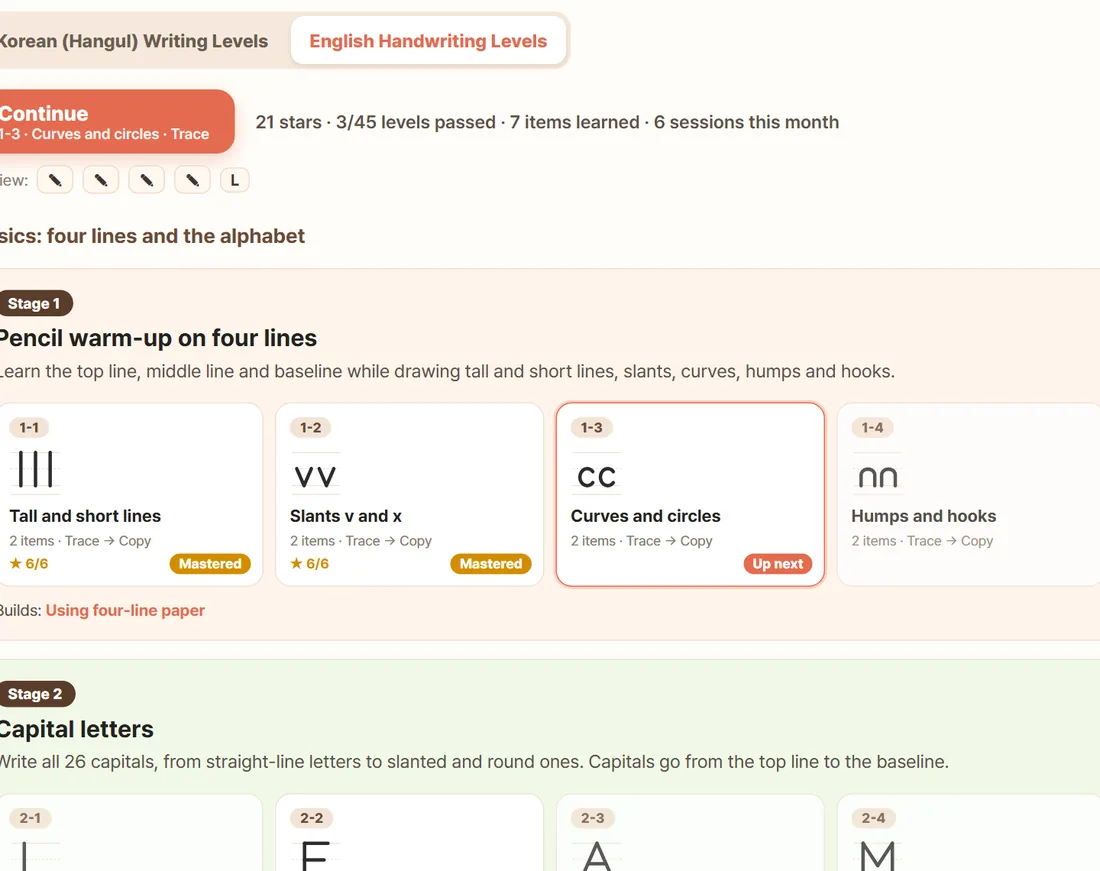
Hangul packs letters into one square, while English letters run side by side and have different heights. So the English course follows its own order: first the heights on four-line paper, then the alphabet, then sounds and words, then sentences.
Capitals go from straight-line letters (L T I) to slanted (A V W) and round ones (C O S); lowercase letters are grouped by how they are formed (c o a, n m h).
2. The 9 stages at a glance
- Basics: 1 four-line warm-up (4 levels) · 2 capitals (8, ending with an A–Z review) · 3 lowercase (9, ending with an a–z review)
- Phonics: 4 short-vowel words, one vowel per level (5) · 5 letter pairs: sh ch, th wh ck ng (2)
- Words: 6 sight words (the, is, you, can…, 5) · 7 picture words: animals and everyday things (4)
- Putting it together: 8 sentences (I can run. / How are you?, 4) · 9 dictation (4)
3. Using four-line paper
- There are four lines: the top line, the dashed middle line, the dark baseline and a light line below it.
- Capitals go from the top line to the baseline.
- Small letters such as a, c, o and n sit between the middle line and the baseline.
- b d h k l t climb to the top line, and g j p q y drop below the baseline. Stage 1’s tall lines, short lines and hooks get the hand used to these heights.
4. Writing words and sentences
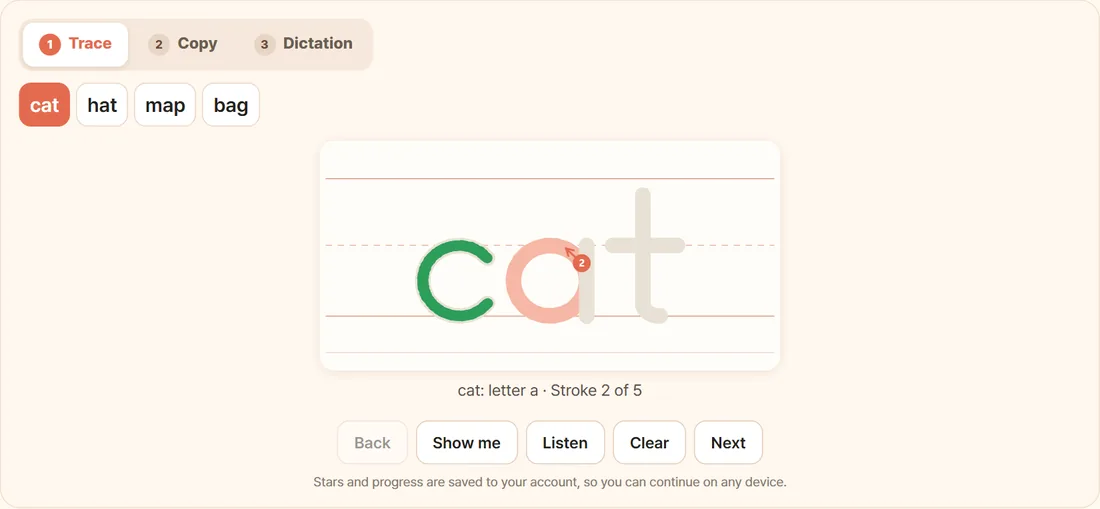
In words the letters run side by side, and the line under the paper tells you which letter is next, such as “cat: letter a · Stroke 2 of 5.” Neighbouring letters are close together (u then n), so words get a slightly tighter check and a stroke from the wrong letter does not pass.
Stage 8 sentences start with a capital letter, end with a period or question mark, and leave spaces between words. Copying short sentences such as “I can run.” practises spacing and punctuation at the same time.
5. b, d, p and q
b, d, p and q look alike and are often reversed. The course separates their stroke orders: a, d, g and q start round like c and then add the line (stage 3, levels 2 and 3), while b and p start with the line and then go round (level 6). The first dictation level asks for b, d, p and q by sound only, as a check.
6. For families learning English as a second language
- On the Korean screens every word also shows its Korean meaning.
- “Listen” uses the device’s English text-to-speech voice; saying the word aloud while writing links the sound and the letters.
- Phonics words come one short vowel per level (cat, hat, map, bag), which makes it easy to compare words with the same vowel sound.
7. Open to everyone, log in to keep going
Every stage is open to everyone, and you can try up to 10 levels right away. To keep going, sign up and log in, with stars and progress saved to your account. Progress from before you log in moves to your account when you log in.
Try the levels from this guide
Open a level to start writing. Every level is open to everyone, and you can try up to 10 levels in each course right away. To keep going, sign up and log in.
FAQ
What age is it for?
Four-line warm-up and capitals suit children from about age 5; phonics words and sentences suit ages 6 to 9 who have started reading the alphabet.
Capitals or lowercase first?
The course starts with capitals, which have more straight lines. Children who already write capitals can start at stage 3.
Is there cursive?
Not yet; the course uses print (manuscript) letters.
I cannot hear the words.
“Listen” uses your device’s English text-to-speech voice. Add or turn on an English voice in your device’s speech settings.
Can I do Hangul and English together?
Yes. The two courses keep separate progress, so alternating one Hangul level and one English level a day works well.