

1. Three passes with less help each time
- Trace: numbered strokes and arrows sit on faint letters, so you learn the order and shape.
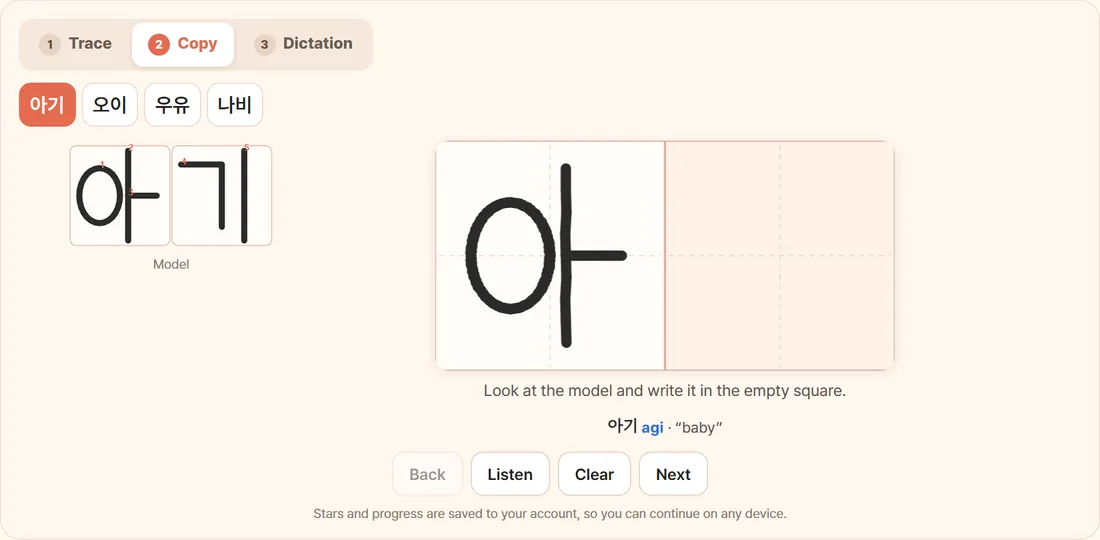
- Copy: the space is empty and a model sits beside it, so you write from memory. If a stroke is wrong, only that stroke is shown again.
- Dictation: no model, only sound. When you finish, the model appears so you can compare. The final dictation stage uses this mode only.
2. How stars are given
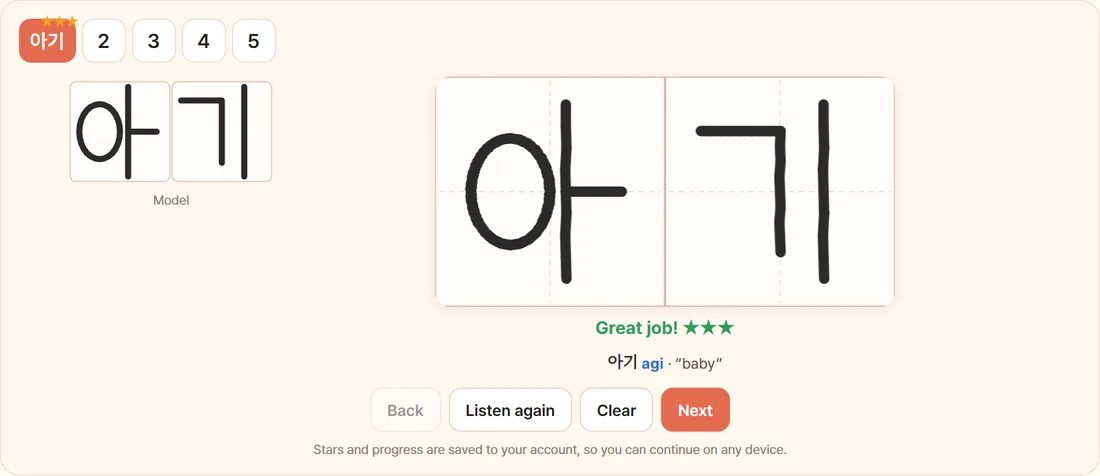
- Each stroke is compared with the model stroke for its start, direction and shape; the closer the strokes, the more stars (1 to 3).
- A wrong stroke is shown again, and help costs stars: one star for every three misses in Trace, and for every two misses in Copy and Dictation.
- If you write an item again, only the higher star count is kept.
3. Passing and mastering a level
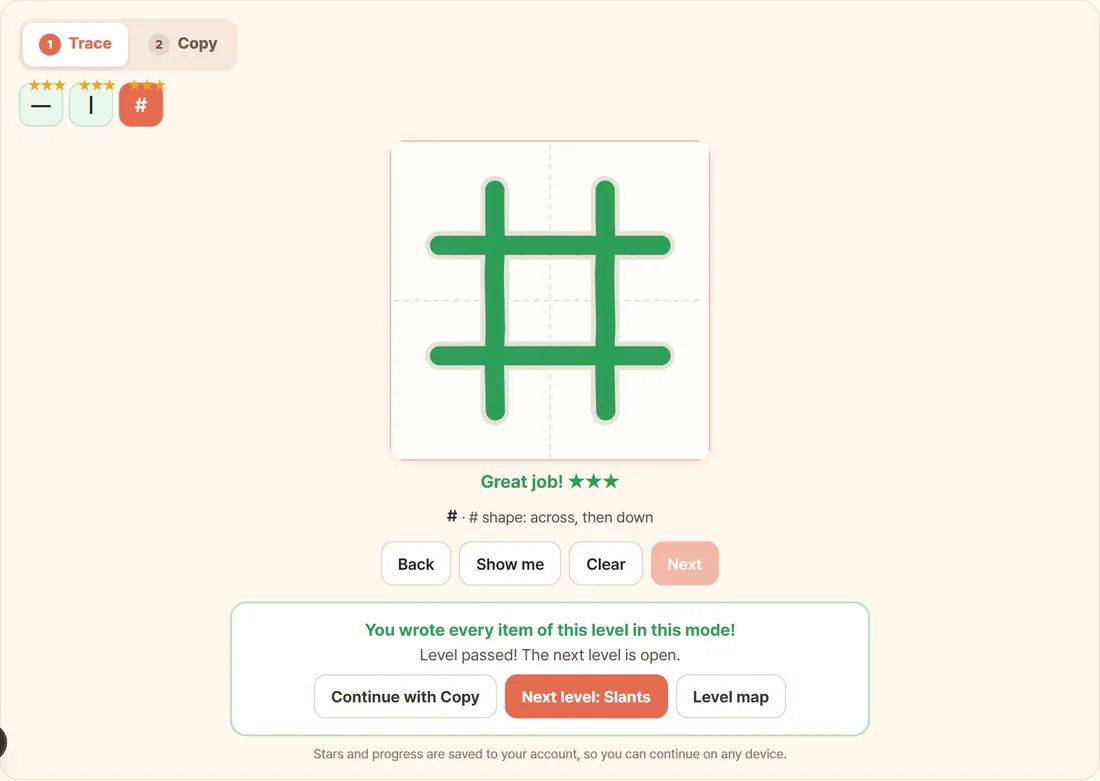
Trace every item in a level with an average of two stars or more and the level is passed, and the next level is suggested. Get two stars on every item in Copy or Dictation and the level is mastered. On the map, passed levels are marked green and mastered levels gold.
When you finish a level, buttons offer to continue with Copy or move on to the next level.
4. Items to review
Members see “Review” on the map: items still at one star after a day, and items learned more than a week ago. Each one links straight to its level.
5. Dictation and device voices
Dictation uses the device’s text-to-speech voice: a Korean voice for Hangul and an English voice for English. If there is no voice, the screen tells you; add one in your device settings.
In dictation levels the item buttons show numbers instead of answers. The model appears when you finish or press “Show answer.”
6. At home
- Each day: one level in Trace and a quick Copy pass of yesterday’s level. Ten minutes is plenty.
- At the weekend, check one level from the week in Dictation; a parent can read the words aloud too.
- Low stars are fine: writing again keeps only the higher score, so encourage another try with “Clear.”
7. In class
- With few tablets, pair up: one child writes while the other reads out the “now writing” line, then swap.
- Write the same items on a printed worksheet as well, so screen and paper practice go together.
- Member progress follows the account, not the device, so a level started in class can be finished at home. Accounts are for ages 16 and up, so children use a parent’s or teacher’s account.
8. Open levels and members
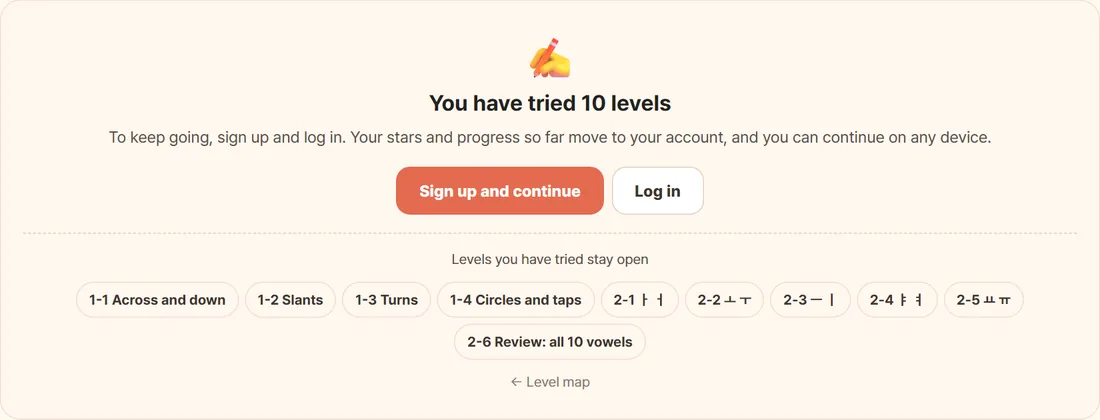
Every Hangul and English level is open to everyone, and you can try up to 10 levels in each course right away; sign up and log in to keep going after that. Members’ learning records (stars per item and how often the levels are used) are used to show progress and are deleted with the account. Pictures of handwriting are not stored.
Try the levels from this guide
Open a level to start writing. Every level is open to everyone, and you can try up to 10 levels in each course right away. To keep going, sign up and log in.
FAQ
Do I have to do all three passes?
Trace alone is enough to pass a level. Copy and Dictation check that the learner can write without seeing the letters, so try them once Trace feels easy.
I keep getting one star.
Check where each stroke starts and which way it goes; “Show me” animates the order. The checker looks at the path and order of each stroke, not the pen thickness.
Can I start over?
You can reopen and rewrite any level; only the higher stars are kept.
Can children create accounts?
Accounts are for ages 16 and up. Children can use a parent’s or teacher’s account.