

1. Why the levels are so short
Writing all 14 consonants in one go is a lot for a beginner. Each level here covers just 2 to 5 items: vowels come two at a time (ㅏ ㅓ), consonants two at a time (ㄱ ㄴ), and every final consonant has a level of its own.
Short levels are easy to finish in one sitting, so learners see a result (stars and a “passed” badge) often. Short, frequent practice tends to be easier to keep up than long sessions.
2. The 12 stages at a glance
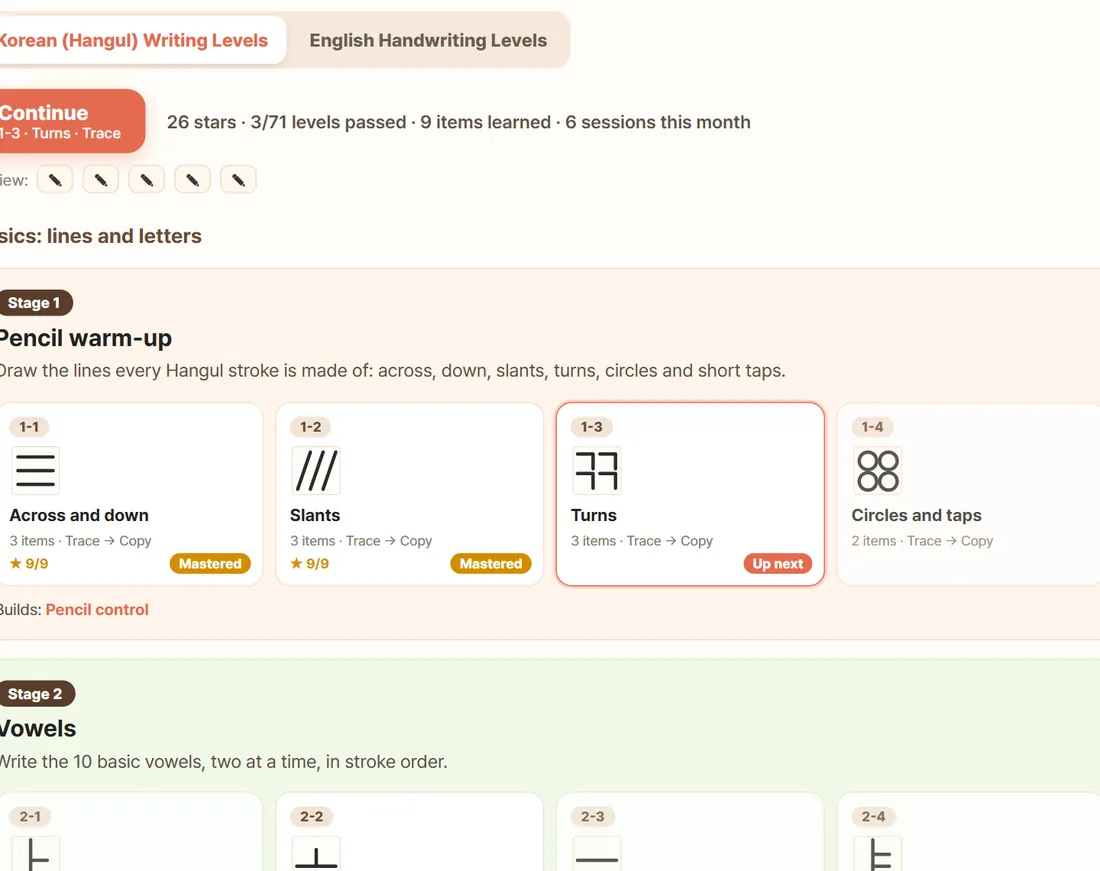
- Basics: 1 pencil lines (4 levels) · 2 vowels (6) · 3 consonants (8)
- How syllables work: 4 vowel on the right (가 거 기, 8) · 5 vowel below (고 구 그, 6) · 6 words without batchim (나비 nabi, 우유 uyu, 바나나 banana, 5)
- Final consonants: 7 one batchim at a time (ㄴ ㅁ ㅇ ㄱ ㄹ ㅂ, ㄷㅅ, ㅈㅊㅌㅍ, 8) · 8 words with batchim (사람 saram, 친구 chingu, 학교 hakgyo, 5)
- Tricky letters: 9 double consonants and combined vowels (까 개 과 왜, 7) · 10 double batchim (닭 dak, 앉다 anda, 읽다 ikda, 4)
- Putting it together: 11 picture words, greetings and short sentences (6) · 12 dictation (4)
3. How each stroke is checked
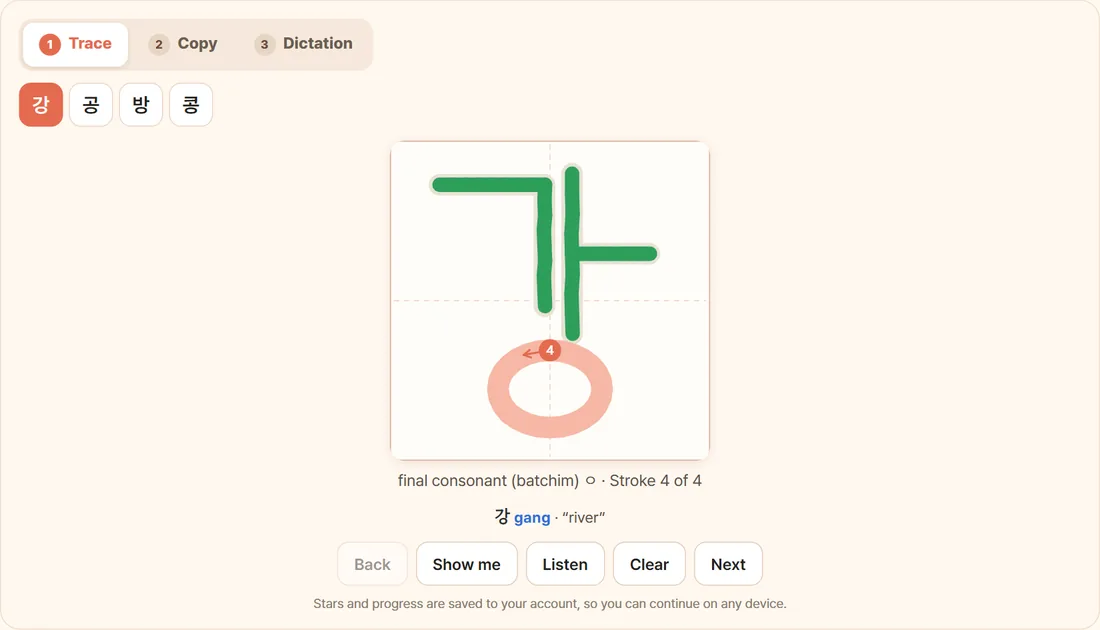
The checker looks at strokes, not just how much of a faint letter you covered. Stroke-order data for each consonant and vowel is scaled into its place in the syllable block (first consonant, vowel, final consonant), so even 강 gang or 닭 dak can be checked stroke by stroke.
While you write, the line under the square tells you what comes next, such as “final consonant (batchim) ㅇ · Stroke 4 of 4.” Each stroke starts at a numbered dot with an arrow, and turns green when the start, direction and shape match. Strokes in small parts of a block, such as a final consonant, get a tighter check so a careless line next to it does not pass.
4. Tips for batchim and double letters
- The final consonant goes at the bottom of the block. Stage 7 practises one batchim at a time, so you can read the same vowel with different endings: 가 ga, 간 gan, 감 gam, 강 gang.
- ㄷ ㅅ ㅈ ㅊ ㅌ at the bottom all sound like t (곧 got, 옷 ot, 낮 nat, 빛 bit, 밭 bat): one sound, different letters.
- Double batchim is written left to right: ㄹ then ㄱ in 닭, ㄴ then ㅈ in 앉다. The spaces are small in stage 10, so slow down.
- Double consonants (ㄲ ㄸ ㅃ ㅆ ㅉ) repeat the same letter side by side; combined vowels (ㅐ ㅔ ㅘ ㅝ) are written first part, then second part.
5. A 10-minute daily plan
- Week 1: the 4 line levels and 6 vowel levels, two or three a day.
- Week 2: the 8 consonant levels, saying each letter name aloud (giyeok, nieun).
- Weeks 3–4: building syllables (stages 4 and 5) and words without batchim, reading each word aloud after writing it.
- After that: batchim → tricky letters → sentences → dictation. Repeat any level whenever you like.
6. For learners of Korean
The English screens show each letter’s name and sound and each word’s romanization and meaning (for example 나비 nabi · “butterfly”). “Listen” uses your device’s Korean text-to-speech voice; if you hear nothing, add a Korean voice in your device settings.
7. Open to everyone, log in to keep going
Every stage is open to everyone, and you can try up to 10 levels right away. Before you log in, progress is kept in this browser, and it moves to your account when you log in to keep going. Levels you have tried stay open.
After 10 levels, a new level asks you to sign up or log in. Members’ stars and progress are saved to the account, so you can pick up on a home tablet or a classroom computer, and the map shows “Continue” and items to review.
Try the levels from this guide
Open a level to start writing. Every level is open to everyone, and you can try up to 10 levels in each course right away. To keep going, sign up and log in.
FAQ
What age is it for?
Lines and vowels suit children from about age 4 who can hold a pencil; batchim and double batchim suit children who have started reading. Adult beginners can start wherever they are comfortable.
Do I have to go in order?
The map suggests starting at stage 1, but you can open any level. If you already know the letters, start at stage 4.
How many levels a day?
A level takes a few minutes, so two or three levels, about 10 minutes, is plenty. Stopping before you get tired makes it easier to come back the next day.
Do I need a stylus?
No. A finger or a mouse works too. With a stylus, resting your palm on the screen will not draw a line.
Is there a paper version?
Letter and picture-word sets on the handwriting pages print as A4 worksheets, a good way to write the same letters once more on paper.